Stump Grinding & Removal in Farragut, TN
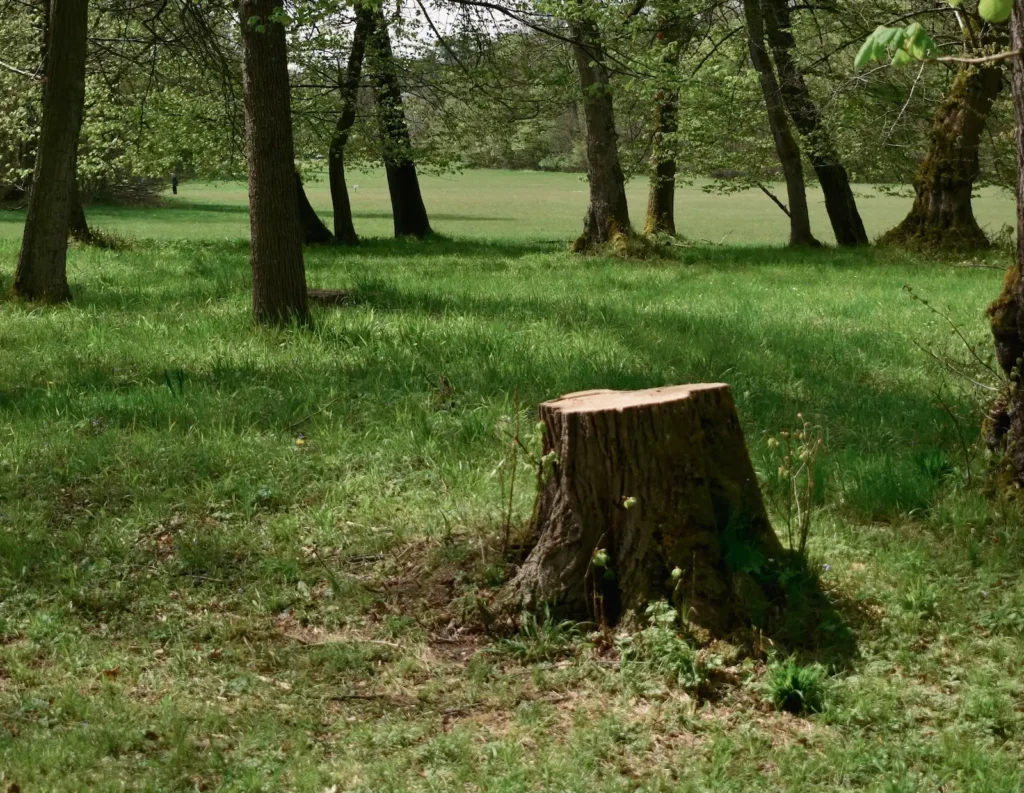
Every established neighborhood in Farragut has them: the stump left over from the oak that came down in a storm five years ago, or the sweetgum somebody removed before you bought the house. The tree is long gone, but the stump keeps costing you. It feeds termites and carpenter ants a few feet from your foundation. It sends up suckers all summer that you cut down and cut down again. It’s the thing you mow around every single week, and if you’re in an HOA neighborhood, it’s the thing the appearance letter mentions.
Grinding it out takes an hour or two. Call or text 865-658-1399 for a free quote — for most stumps, a photo with something for scale (a boot works) gets you a ballpark the same day.
Still have the tree standing? Start with our tree removal page — grinding bundles easily into the same visit.
What Stump Grinding Actually Is
A stump grinder is a machine with a carbide-toothed cutting wheel that chews the stump into wood chips, pass by pass, from the top down. We grind the stump and the visible rootball flare down to below grade — deep enough to cover the spot with soil and grow grass over it like the tree was never there.
A few honest facts most companies don’t bother explaining:
Standard depth is enough for grass, not always for construction. Four to twelve inches below grade handles reseeding, sod, and most landscaping. If you’re planning to pour concrete, build a deck footing, or replant a tree in the exact same spot, say so — those jobs can call for deeper grinding, and it’s better to do it in one visit.
Grinding doesn’t remove the root system. The lateral roots stay in the ground and decay naturally over the next several years. That’s normal and almost never a problem — but it’s why you’ll occasionally see slight settling over old root runs, and why replanting a new tree in the identical hole is harder than planting three feet away.
The chips belong to you. Grinding a decent-sized stump produces a surprising pile of wood chips. We can rake them into the hole and mound them (they settle as they compost), spread them as mulch in your beds, or give them to a neighbor. Your call.
East Tennessee soil keeps things interesting. The rocky clay under most of Knox County means grinder teeth meet chert and rock more often than they would in bottomland — it’s one of the factors that can affect time on bigger stumps, and one more reason a photo or a look at the stump beats a blind quote.
What Stump Grinding Costs in the Farragut Area
Here are honest market ranges for our area. Every stump is different — access, rootball size, rock, and what’s buried nearby all matter — so treat these as ballparks, not quotes. The real number takes one look or one photo: 865-658-1399.
| Stump Size (diameter at ground level) | Typical Range |
|---|---|
| Small — under 12″ (dogwood, ornamental, crape myrtle) | $75 – $150 |
| Medium — 12″ to 24″ (most maples, pines, average yard trees) | $150 – $300 |
| Large — 24″+ (mature oaks, sweetgums, old-growth hardwoods) | $300 – $600+ |
| Multiple stumps, same visit | [MULTI-STUMP POLICY — typically discounted per additional stump] |
What moves the price up or down:
- Access. A stump in the open front yard is easy. A stump behind a fence gate, on a lakefront slope off Northshore, or between the house and the neighbor’s fence takes a smaller machine and more time.
- Rootball flare. A 20-inch trunk with a 40-inch flare of surface roots is really a 40-inch job.
- Rock. Hit enough chert and the job slows down.
- What’s nearby. Stumps tight against foundations, driveways, irrigation lines, or utility markings get ground carefully, which takes longer.
Measure your stump across at ground level — including the flare — and text the number and a photo to 865-658-1399. You’ll get a real range back fast.
Grinding vs. Full Stump Removal
Full removal means excavating the stump and rootball out of the ground with machinery — a much bigger disturbance that leaves a crater, tears up the surrounding yard, and typically costs several times more.
For nearly every residential situation in Farragut, grinding is the right answer: it’s faster, far cheaper, and leaves your yard intact. Full excavation makes sense mainly when the ground is being dug up anyway — new construction, a pool, a foundation addition — and the site work is already on someone’s schedule. If your project is in that category, we’ll tell you straight and point you the right direction rather than sell you the wrong service.
What the Spot Looks Like Afterward
When we finish, you have a shallow depression filled with wood chips where the stump was. From there:
- Leave the chips mounded and they’ll settle and compost over a season or two — the zero-effort option.
- Rake out the chips, backfill with topsoil, and seed or sod — the spot disappears into the lawn in a few weeks during growing season. Expect to top off the soil once after the first heavy rains settle it.
- Replanting? Plant the new tree a few feet from the old spot, not in it — fresh chips tie up nitrogen as they decompose, and the old root mass is still down there.
Just Need a Stump Gone? That’s a Real Job to Us
Plenty of our stump calls have no tree attached. The tree came down in a storm years ago, or another company removed it and quoted a stump price that didn’t make sense, or you just closed on a house that came with three stumps in the backyard. Stump-only visits are welcome — you don’t need to be a “full-service” customer to get on the schedule. We grind stumps across Farragut, West Knoxville, Hardin Valley, and Concord, and out to Lenoir City and the Fort Loudoun lakefront.
Stump Grinding Questions, Answered
How long does it take?
Most single residential stumps take 30 minutes to 2 hours on site, depending on size, rock, and access. Even a big oak stump is usually a same-morning job. Multiple stumps stack efficiently in one visit — which is why the per-stump price drops.
Can you grind a stump close to my foundation or driveway?
Usually, yes. We control the grinding depth and angle near hardscape and structures, and we work the near side by hand-guided passes. What we won’t do is grind blind against something that can’t be repaired cheaply — if a stump is genuinely fused against a foundation, we’ll grind what’s safe and tell you honestly what has to stay.
Will the tree grow back after grinding?
The stump itself won’t — grinding below grade destroys the growth tissue at the base. Some species (sweetgum, Bradford pear, black locust are the usual suspects around here) can send up sprouts from surviving lateral roots for a season or two. Mow them or cut them and they give up; the roots are running on stored energy with no leaves to replace it.
Do I need to call 811 before you grind?
This one matters. Standard grinding depth can reach shallow buried lines — irrigation, low-voltage lighting, cable drops, and occasionally gas or electric service runs. Tennessee 811 locating is free, and the safe rule is simple: if there’s any chance of buried utilities near the stump, the area gets located before grinding. We’ll talk through what’s near your stump when we quote it and make sure locating happens if it’s warranted. A free phone call is always cheaper than a cut gas line.
Get Your Stump Quote Today
Measure it, photograph it, text it: 865-658-1399. Or just call and describe it. Either way you’ll get an honest range, a real appointment, and a yard you can finally mow in a straight line.
865-658-1399 — Stump grinding for Farragut, West Knoxville, Hardin Valley, Concord & Lenoir City.