Tree Removal in Farragut & West Knoxville
Tree removal Farragut, TN homeowners can actually get scheduled. Nobody plants a tree hoping to remove it. But trees age, storms happen, and the mature oaks and poplars that make established Farragut neighborhoods feel established are also sixty, eighty, a hundred feet of weight standing over houses, driveways, and kids’ trampolines. Some trees can be saved with good pruning — and when that’s true, we’ll tell you, because it’s cheaper for you and better for the street. Others are done: dead, dying, structurally compromised, or simply growing in a place where they can no longer be safe.
When it’s time, the job is to bring the tree down in a controlled way, protect everything around it, and leave the yard clean. That’s this page. For a free assessment, call or text 865-658-1399.
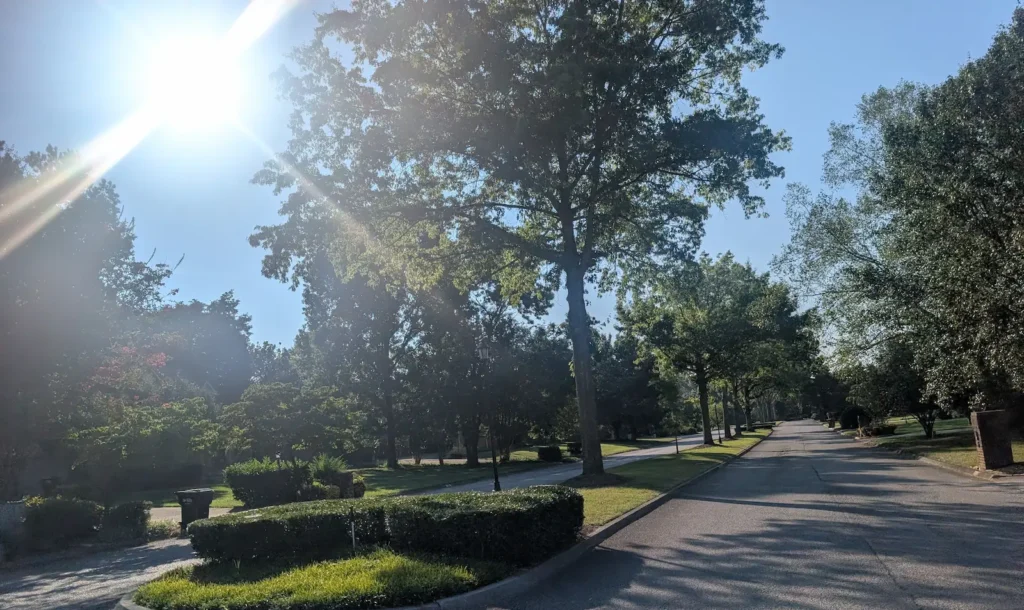
Signs a Tree Needs to Come Down
You don’t need to be an expert to spot most of the warning signs. Walk your yard and look for:
- Dead limbs in the upper canopy — bare branches in summer while the rest of the tree leafs out. Trees die from the top down.
- Mushrooms or shelf fungus at the base — fruiting fungus on the trunk or root flare usually means decay inside, where you can’t see it.
- Cracks or seams in the trunk — especially vertical cracks, or a spot where two trunks meet in a tight “V” that’s starting to split.
- Soil lifting on one side — a leaning tree with mounded or cracked soil opposite the lean is telling you its roots are losing grip. After a wet spring, take this one seriously.
- Heavy woodpecker activity — woodpeckers eat insects that eat dead wood. A tree the woodpeckers love is often a tree that’s rotting.
- A lean that’s new — trees can grow at an angle their whole lives and be fine. A lean that appeared after a storm is different.
None of these automatically means removal — some mean “prune it,” some mean “watch it.” Send a photo to 865-658-1399 and you’ll get an honest read either way.
How We Remove a Tree Safely
Every removal starts with the same question: what’s underneath and beside this tree? The answer decides the method.
Open felling — when there’s room to lay the tree down in one piece, that’s the simplest and cheapest removal. On larger rural-edge lots toward Lenoir City, it happens. In most Farragut neighborhoods, it doesn’t.
Sectional takedown — the standard method on tight lots. A climber or lift works the tree down from the top in pieces: limbs first, then the trunk in sections, with each piece rigged on ropes and lowered under control — not dropped — when there’s anything below worth protecting. This is how a 70-foot oak comes out of a backyard with a fence on three sides and a sunroom on the fourth, without touching any of them.
Crane or bucket work — some trees earn heavier equipment: very large trunks over structures, dead trees too rotten to climb safely, or spots where rigging points don’t exist. For the rare jobs that need a crane, we’ll tell you upfront and coordinate it.
Whatever the method, protection comes first: plywood over septic areas and irrigation heads where needed, mats for equipment on soft lawns, and a plan for the drop zone before a saw starts. On lakefront slopes off Northshore, where access is tight and gravity is not your friend, the plan is most of the job.
What Tree Removal Costs in the Farragut Area
Honest ranges for our market. Every tree is its own job — these are ballparks to help you budget, not quotes:
| Tree Size | Typical Range |
|---|---|
| Small — under 30 ft (dogwood, ornamental, small pine) | $300 – $700 |
| Medium — 30–60 ft (most maples, average yard oaks, larger pines) | $700 – $1,500 |
| Large — 60 ft+ (mature oaks, poplars, big sweetgums) | $1,500 – $3,500+ |
| Dead or hazardous trees | Add a premium — dead wood is unpredictable and takes slower, more careful work |
What moves the number:
- Proximity. A tree in the open costs less than the same tree over your roofline, your neighbor’s fence, or a pool screen.
- Access. Can equipment reach it, or does every piece get carried out through a 36-inch gate?
- Condition. Sound wood holds rigging; rotten wood doesn’t. Dead trees cost more for a reason.
- Cleanup scope. Haul everything vs. buck-and-leave the wood changes the labor.
Stump grinding is priced separately — most removals leave the stump unless you add grinding, and most people add it. See our stump grinding page for those ranges, or bundle both in one quote: 865-658-1399.
What’s Included in Every Removal
The quote covers the whole job, in writing: the takedown, limbing and chipping of the brush, wood hauled off or bucked into firewood lengths and left — your choice — raking the work area, and blowing off the driveway. The only thing left behind should be the stump — and only if you didn’t ask us to grind it.
Tree Already Down — or On the House?
If a storm did the removal for you and there’s a tree on a structure, a driveway, or blocking access, that’s a different kind of call — go to our storm damage response page or just call 865-658-1399 and say the word “emergency.” Making it safe comes first; the cleanup plan comes second.
Where We Work
We remove trees across Farragut and West Knox County — Cedar Bluff to Rocky Hill, Hardin Valley, Concord — plus Lenoir City and the Fort Loudoun lakefront. If your lot has mature hardwoods and an HOA, you’re in the heart of our service area.
Tree Removal Questions, Answered
Do I need permission to remove a tree on my own property in Farragut?
For most trees on private residential lots, no — but there are exceptions worth checking: trees in easements or designated buffer zones, and HOA covenants that require approval before removing significant trees. If your lot backs a greenway or your HOA has an architectural committee, spend ten minutes with your covenants first. We can help you figure out what applies. (General information, not legal advice.)
How long does a removal take?
Most single-tree residential removals are done in half a day to a full day, including cleanup. Very large trees, difficult access, or multiple trees can run longer — the written quote comes with a time estimate so you know what to expect.
Will removing the tree damage my lawn?
Some impact is honest to expect — chips, sawdust, and equipment tracks happen. The difference is whether the crew manages it: mats under equipment on soft ground, plywood over sensitive spots, and a real cleanup at the end. Lawns recover from a careful removal in weeks. What you shouldn’t accept is ruts, crushed irrigation heads, or a debris field.
Can you remove a tree near power lines?
Careful answer, because this is where tree work gets dangerous. Lines fall into two categories. Utility-owned lines — the primary lines running pole to pole along the street — are the utility’s territory; trees into those lines get reported to the utility (in most of our area, that’s the local utility district or KUB), and their crews or contractors handle clearance around energized primaries. Service drops — the single line from the pole to your house — are a different situation: work near them requires coordination, sometimes including a temporary drop disconnect by the utility, before removal proceeds. What we will never do is treat a tree tangled in energized lines as a normal removal. If your tree involves wires, tell us when you call — the plan changes, and that’s the point.
Get an Honest Tree Assessment
Whether it’s a dead pine that needs to go this month or a leaning oak you just want a professional opinion on, the assessment is free and the answer will be straight — including when the answer is “that tree’s fine.”
Call or text 865-658-1399 — free tree removal estimates for Farragut, West Knoxville, Hardin Valley, Concord & Lenoir City.